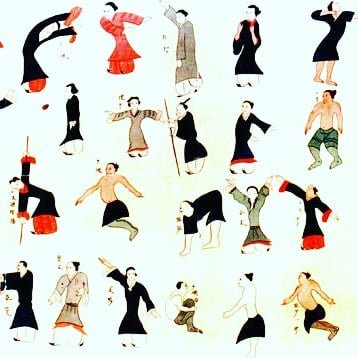
Qigong is often described as a gentle practice — slow movements, soft breath, quiet awareness. But beneath its simplicity lies a profound internal path. Progress in Qigong rarely arrives through dramatic breakthroughs. Instead, it unfolds quietly, shaped by patience, consistency, and the willingness to revisit foundational principles again and again.
Below are some reflections that capture the essence of long‑term Qigong practice. Each begins with a core ‘teaching’ and expands into a deeper exploration of how it reveals its wisdom over time.
I hope that this discussion will provoke a deeper exploration of Qigong and a revisiting of your own practice.
“The more you chase unusual experiences, the further they seem to get away.”
Some Qigong instructors focus on finding and experiencing the Qi, or the sensation of Qi, as a sort of confirmation that the Qigong is working. There is nothing wrong with this, but it can create a slippery slope, setting expectations that may not be realised. I’ve heard it said many times that once you have been doing Qigong for some time, you will experience the Qi or the sensation of the Qi. Doing Qigong affects your Qi; it will move, be stimulated, gathered, refined, balanced, stored, and the list goes on whether you feel the Qi or the sensation of Qi.
If you do feel some sensation, such as tingling or warmth, between the palms while doing a particular Qigong movement, such as holding the ball, it may happen on this occasion but not the next time you practice. This is an incredibly common experience.
Many students can enter Qigong hoping for dramatic sensations: waves of warmth, tingling, spontaneous movement, emotional release. These experiences can happen — but chasing them is the fastest way to prevent them and is not the ultimate purpose of Qigong.
Qigong works through softness, not force. When you try to “make something happen,” you tense the body and scatter the mind. The conditions that allow Qi to move naturally disappear.
The most meaningful experiences arise when you stop grasping and simply practice with presence (Yi*). If a Qi sensation arises during practice, treat it as a curiosity, not a destination or confirmation that the Qigong is working. Notice it with interest but let it pass as clouds pass across the sky.
I know in my own experience when I have experienced the Qi sensation between my palms in one session on a particular day and been expecting it on the next occasion it hasn’t been there. It does not mean your Qigong is not working.
“Real progress often begins when you stop looking for fireworks.”
This is an extension of the conversation above. Qigong is not a ‘fireworks’ practice. It is a cultivation practice. Obviously, we come to Qigong with a motive: to improve health, manage stress, etc.; there is an expectation at some level that the time and money you are spending will result in an outcome. Generally, every person will feel different from the beginning of a Qigong class to the end of a class, as you may from any movement-based activity. However, Qigong is vastly different from a Pilates or gym workout.
Real progress shows up quietly:
– your breath deepens
– your joints soften
– your reactions slow
– your awareness expands
– your nervous system steadies
These subtle shifts form the foundation for everything else. When you stop expecting every session to be extraordinary, you begin noticing the extraordinary within the ordinary. Over time, energy may increase, joints may improve, calmness of mind may occur, and health issues may improve. You may become more aware of your body and its sensations beyond those gross sensations of pain and stiffness.
Each Qigong class or session you do builds on the previous; it becomes a cultivation and a journey into improving the internal workings of the body-mind. This is what leads to better health both physically and mentally.
“Your body learns more slowly than your intellect.”
One of the most humbling truths in Qigong is that the body operates on a different timeline than the mind. You can read about sinking the Qi, activating the microcosmic orbit, concentrating Qi in the lower Dantian, Shen rising, drawing Qi into energy gates, lengthening the spine, or relaxing the chest and understand these principles instantly. Intellectually, they may make perfect sense. But Qigong is not an intellectual art — it is an embodied one. And embodiment unfolds slowly.
The body carries decades of conditioning: tension patterns, protective bracing, dysfunctional breathing patterns, emotional contractions, habitual posture, and unconscious reactions to stress. These patterns don’t dissolve just because you understand they exist. They dissolve through patient, repeated practice through showing up, softening a little more each day, and giving the nervous system time to trust new ways of moving and being.
This is why Qigong can feel deceptively simple. You “know” what to do, yet your body doesn’t immediately comply. You may understand sinking, but your shoulders still creep upward. You may understand relaxation, but your chest still tightens under pressure. You may understand rooting or grounding, but your weight still floats upward when you’re distracted. None of this is failure; it is the natural process of somatic learning*.
Qigong rewires the body from the inside out. It teaches the fascia to soften, the joints to open, the breath to deepen, and the mind to settle into the body rather than hover above it. This takes time. It takes repetition. It takes kindness toward yourself as you navigate the gap between knowing and embodying.
That gap is the practice. It is where transformation happens. And the more you honour the body’s pace, the more profound your progress becomes.
“Consistency beats intensity.”
Qigong is a practice built on rhythm rather than effort. The body responds far more deeply to regular, gentle nourishment than to occasional bursts of enthusiasm. When you show up daily, even briefly, you give your nervous system a predictable pattern to settle into. This steadiness allows the breath to deepen, the joints to soften, and the Qi to circulate without obstruction. Note: “a short daily practice nourishes the body far more effectively than sporadic long sessions,” and this reflects one of the oldest truths in internal cultivation: the body learns through repetition, not force.
Intensity often activates tension. When you push too hard, the shoulders lift, the breath tightens, and the mind becomes goal‑oriented. These reactions pull you out of the very qualities Qigong is trying to cultivate: Song*, softness, alignment, and quiet awareness. Consistency, on the other hand, invites the body to trust the process. A gentle, daily rhythm signals safety. It gives the fascia time to unwind, the meridians time to open, and the mind time to settle into the body rather than hover above it.
Over time, this steady approach reshapes your internal landscape. Even ten minutes of relaxed movement each day gradually reorganizes the nervous system and encourages the Qi to flow more freely. The changes are subtle at first: a calmer breath, a softer chest, a quieter mind, but they accumulate. Each session builds on the last, creating a continuity that sporadic intensity simply cannot match. Note: “Consistency leads to integration,” and integration is what transforms Qigong from an exercise into a way of being.
The deeper truth is that intensity creates moments, but consistency creates change. Intensity is exciting, but consistency is transformative. When you nourish the practice gently and regularly, Qigong becomes part of your body, part of your breath, and part of your daily life. That is where its real power lies.
Short daily sessions:
– keep the meridians open
– maintain softness in the joints
– regulate the breath
– stabilize emotional energy
– prevent stagnation
– gently release the fascia
“The hardest part of Qigong isn’t learning the exercises.”
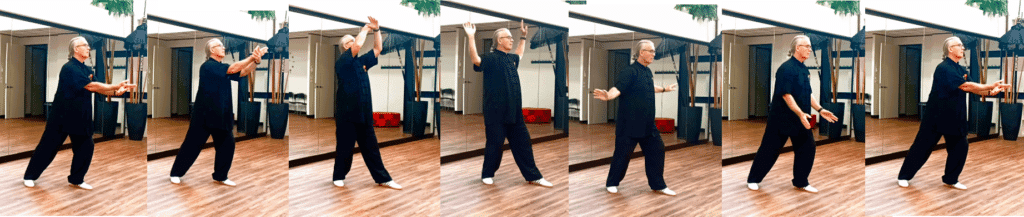
Most Qigong forms are relatively simple. The movements are accessible, the choreography is not overly complicated, and the physical demands are generally modest. A beginner can learn the outward shapes of a form in several sessions. This simplicity often surprises people, especially those who come from movement traditions where complexity, speed, or strength are markers of progress. In Qigong, the external form is intentionally uncomplicated, not because the art lacks depth, but because the depth is hidden inside the simplicity.
The real challenge is staying interested in that simplicity long enough for it to reveal its richness. Qigong does not reward novelty; it rewards refinement. The foundational principles- Song*, alignment, intention, breath, awareness, rooting — are not beginner concepts. They are lifelong studies. You return to them again and again, each time discovering a deeper layer. What looks simple on the outside becomes profound on the inside, but only if you remain patient enough to keep exploring the basics rather than rushing toward something new.
Many students feel tempted to pursue “advanced” techniques, believing that complexity equals progress. They assume that more movements, more choreography, or more dramatic sensations indicate deeper skill. Also, the idea of learning more and more forms equals progress is misleading. It reminds me of the saying, “Jack of all trades, and master of none.” But the internal arts do not work this way. Advanced and more forms do not create advanced practitioners. Refined basics do. The body transforms from the inside out through repeated attention to alignment, softness, breath, and intention — not through accumulating more techniques.
This is why the simplest practices in Qigong, such as standing meditation or slow repetitive movements, often produce the most profound internal change. They give the nervous system time to settle, the fascia time to unwind, and the Qi time to reorganize itself. When you stay with simplicity, you begin to feel the subtle qualities that cannot be taught through words: the quiet sinking of the Qi, the soft opening of the joints, the gentle expansion of awareness, the sense of being moved rather than moving.
The hardest part of Qigong is not learning the exercises; it is learning to value the simplicity that makes the exercises transformative. When you commit to refining the basics, the practice stops being something you do and becomes something you experience. That is where Qigong begins to reveal its true depth.
Zhan Zhuang, also known as ‘pole standing ’, is a very simple-looking practice, but can be transformative. At its simplest, it is simply standing in one spot and applying the principles of Qigong: Focus/intention (Yi*), body alignment, and breathing. The problem that arises for most of us in the modern world is that it is too simple and can be seen as boring because you aren’t doing anything in terms of choreography. The process is internal.
“The deepest lessons are usually the first ones you were taught — you just weren’t ready to see how profound they really were.”
Every Qigong lineage begins with the same foundational teachings: relax, align, breathe, sink, soften, feel. These instructions appear simple, almost obvious, and many students treat them as beginner concepts to be mastered quickly before moving on to something more advanced. “These are not beginner lessons — they are lifelong lessons.” The internal arts do not hide their depth behind complexity. They hide it inside repetition.
When you first encounter these principles, you understand them only at the surface level. You relax the muscles but not the deeper tissues. You align the posture but not the internal structure. You breathe more slowly but not more fully. You sink the Qi in theory but not in sensation. At the beginning, your awareness is simply not refined enough to perceive what these teachings truly mean. The principles are profound from the start — but you are not yet able to feel their depth.
As your practice matures, something shifts. The same instructions you heard on your first day suddenly reveal new layers. Relaxation becomes Song*. Alignment becomes internal organization. Breath becomes a bridge between mind and body. Sinking becomes a felt descent of Qi through the tissues. Awareness expands from the surface to the interior. What once felt simple now feels subtle. What once felt physical now feels energetic. You return to the same teachings, but you are no longer the same student.
“Your Qigong doesn’t change — you change.” The principles remain constant, but your capacity to perceive them grows. Your nervous system softens, your sensitivity increases, and your internal awareness becomes more refined. Teachings that once seemed basic begin to feel profound, not because they were incomplete, but because you were still developing the ability to understand them from the inside.
The deepest lessons in Qigong are not hidden in advanced forms or complex techniques. They are embedded in the first instructions you ever received. You revisit them again and again, each time discovering a new dimension. This cyclical return is not repetition; it is evolution. The principles were always deep; you simply needed time, practice, and maturity to see how deep they truly were.
In the end, Qigong reveals itself not through novelty, but through familiarity. The teachings stay the same. You grow into them.
Definitions:
Somatic learning: is the body’s way of absorbing and integrating new patterns through felt experience, repetition, and internal awareness — not through thinking or theory.
*Yi: in Qigong refers to intention, directed awareness, or mindful focus. It is the gentle mental guidance that leads the movement of Qi.
Yi is not forceful concentration. It is a soft, quiet, steady awareness that subtly directs the body and breath. When practitioners say “use Yi, not Li,” they mean: guide the movement with intention, not muscular effort.
*Song: is a state of relaxed, elastic openness in the body where unnecessary tension dissolves, the joints gently open, the breath deepens, and the Qi can move freely. It is relaxation with structure — softness without collapse.
Song feels like the body “letting go” while simultaneously becoming more connected, aligned, and stable. The muscles release excess effort, the fascia unwinds, and the weight settles downward through the bones. This creates a sense of grounded lightness: the body feels softer, yet more alive; more stable, yet more fluid.
Song is not something you do — it is something that emerges when the body stops doing what it doesn’t need to do.
Yours in Qigong
Sifu Peter
